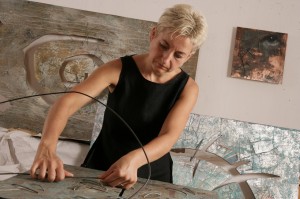
The artist at work
Ludmila Pawlowska was born in exile.
When Joseph Stalin took power in Russia in the 1920s, he started pushing troublesome people — teachers, artists, intellectuals, ethnic groups — far away from the country’s center of power.
Everyone knows about the gulags in Siberia, but that wasn’t the only place of exile in the Soviet Union. Kazakhstan, the biggest and most remote of the “stans,” was another. Ludmila’s Kazak home, the city of Karaganda, was hundreds of miles from any other urban area.
It was a mid-sized city — about a million population today — and it was full of highly educated exiles, culture and good schools, where teachers spotted her early as a born artist.
Her family had been shattered by the revolution. Her grandfather was deported to Siberia in 1936, when her father was two-years-old. Her uncles were taken by the state, separated and scattered across the nation to homes for children of state enemies.
Her father was a dissident, too – always limited by his refusal to join the Communist Party. She and her father weren’t close – but her mother was her soul mate. And art was her refuge.
Ludmila (“Just call me Mila,” she says, “it’s easier”) was considered a child prodigy. She still has newspaper clippings written about her in the elementary school years.
At 15, she left her beloved mother and went to Moscow.
Socialist Realism was the party-enforced painting style of the day, but the academies were good, and Mila’s passion for art never flagged. She worked her way into textile design and magazine illustration.
The Stalin era ended when he died in 1953. Soon, Nikita Kruschev opened the gulags, and her grandfather was free — but not free to leave Siberia.
She met Jan Lech — an early-music specialist and lutenist who had moved into the business side of the arts — and they started dreaming of a rural life together. They wanted to start a center where artists and art-lovers could come together, and Jan knew an area in Sweden that would be perfect.
So 20 years ago, they left Russia. For the first time, Mila was free to become the artist she was born to be. Her early work in Sweden was all about the natural beauty she saw around her: florals and landscapes, somewhere between realistic and abstract and influenced by her work in textiles.
After a few years, her mother was able to come for an extended visit. A few months into the visit, she had a massive stroke and died. Mila’s life changed overnight. In her heart and in her painting, she began a spiritual journey.
She traveled, looking for answers. In Russian monasteries — opened up by growing political liberalism — she found ancient wisdom and contemporary icons painted in the classical style. “The icons were like a window to God,” she says.
Today, she’s an abstract expressionist, making art that’s more about her heart than her eye — about what she senses all around her, about what has come to her through those classical windows and been incorporated into her work. She carved letters to her mother in her paintings as a heavily textured, almost sculptural style evolved.
Her paintings helped her exorcize her feelings. “I knew my mother surrounded me and could hear me. She could read my letters to her. After every image was done, I felt a sense of relief. I was finding my own way to God. All the art over these last years has been a spiritual journey.”
About the Art & Icons
Volunteer To Be a Guide
Back to Icons in Transformation Main Page