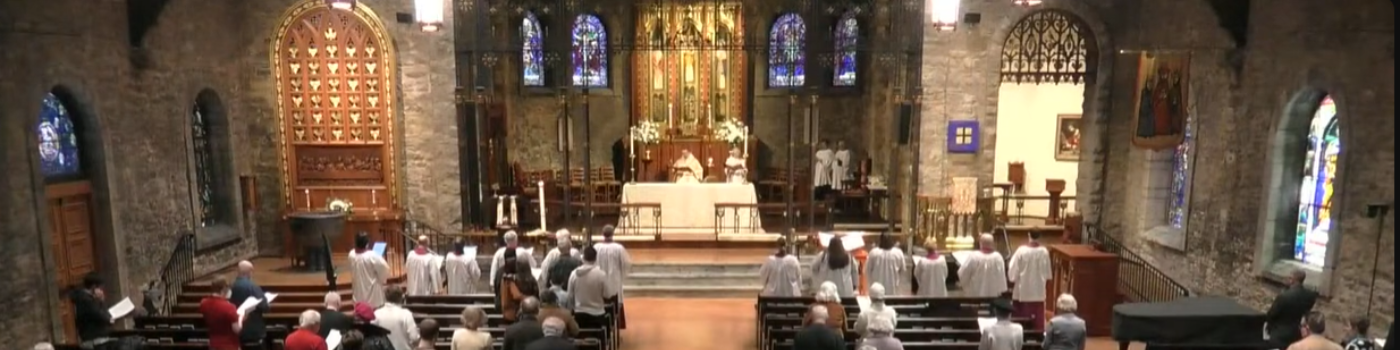
| The Organ at Grace & Holy Trinity Cathedral One of the many wonderful assets that draw people to Grace and Holy Trinity is the music: the voices of the Trinity Choir and the powerful notes of the Kney Organ enhance worship and the many services at the Cathedral. The organ, designed by Gabriel Kney and installed in a specially constructed Gallery at the west end of the Nave, was dedicated on April 26, 1981. |
| However, as many are aware, the organ is exhibiting signs of aging; it is nearly fifty years old, and the cutting-edge technology of its time has deteriorated. Last year, the organ was inspected by two organ-building companies: C.B. Fisk Inc. of Gloucester, Massachusetts, and Richards, Fowkes & Co. of Collegedale, Tennessee. Both essentially reached the same conclusion: a rebuild, while possible, would be expensive (60-70% of the cost of a new organ) and would not significantly address identified deficiencies, which include: The Action, which uses Fiberglass and Teflon rods, would need to be completely replaced and updated; components have stretched and frayed, and often get tangled. In addition, the Windchests would also need to be rebuilt. Another problem is that many of the soft metal pipes are not properly racked (supported) and bend, leading to kinks (like with a hosepipe), making certain notes inoperative or contrary – it has been suggested that at times there are sounds akin to a squawking goose! It is due to the creativity and dexterity of our Directors of Music that these problems are resolved, unfortunately, only for a short time; to correct them, the whole organ would need to be dismantled and rebuilt. The organ is very constricted, placed to the side of the gallery to respect the Tiffany Hart window and hard against the roof of the Nave, leading to poor ventilation and difficulties with maintenance; in summer, high temperatures can render the organ unplayable, and the compressed layout of the pipe divisions makes access difficult and unsafe, even scary. Later this year, we will plan for small groups to ascend to the gallery and view the “guts” of the organ to better understand these problems. While problems have been identified with the organ itself, others need to be addressed, including: The HVAC (Heating, Ventilation, and Air Conditioning) for the whole Nave needs to be reconsidered to ensure comfort and to eliminate the intrusive background noise of the ductwork and equipment. During many concerts, the system is turned off completely to make for a quiet environment, while the design, connecting the ductwork for the Chancel to that for the south side of the Nave, leads to considerable temperature variations …. and complaints. The Gallery, which was specially constructed for the installation of the Kney Organ, is not ADA accessible for the handicapped; the one staircase is very steep, and there is no legal alternative fire escape route – even the bravest of people think twice when shown the rope ladder thrown over the balcony railing! C. B. Fisk and Richards, Hawkes are both very hesitant to provide services for a rebuild of the Kney Organ; they consider that the resulting instrument would not meet their exacting standards or the expectations for an organ of the 21st Century. Both firms recommend that Grace & Holy Trinity Cathedral investigate the design and installation of a new organ. Moving forward, we are in discussions with C. B. Fisk to develop specifications and concepts for a new organ. |
| Recently, a trip was made to Pittsburg, Kansas, where organs by Fisk were seen at the First United Methodist Church (2016) and at McCray Hall on the campus of Pittsburg State University (1996). Both are magnificent instruments, and our Director of Music played both while, as Fisk’s maintenance technician was on site, we were able to climb inside and inspect both organs, seeing how inaccessible and dangerous our organ is compared to more recent builds. This trip clarified that Fisk builds wonderful organs and is the firm to build a new instrument for our Cathedral. Obviously, a new organ is a huge undertaking and will take considerable effort by the Cathedral community. While the Director of Music is developing specifications for the configuration, it is vitally important that other considerations are addressed: liturgical needs, location and configuration, structural integrity, support services (electrical, mechanical, lighting, and audio visual), future uses (for example, concerts and other events); all while respecting the history and historic elements of the fabric. |
| The Tiffany Hart window at the west end of the Nave is a magnificent treasure; Kney acknowledged it by placing the 1980 organ to the south side of the gallery, resulting in the problems mentioned above. An organ that was seen by attendees at the 2026 Episcopal Parish Network conference in Charlotte, North Carolina, at St. Peter’s Episcopal Church, shows a potential solution for acknowledging such a special window: the organ case is shaped to frame and showcase the window. There is much work to be done; we are currently at the earliest stages. More detailed information will be shared this coming Fall when the overall direction is being finalized, and conceptual images are available. Financial viability is a major concern, and to that end, a Capital Campaign will be announced to raise funds for the new organ and its peripheral needs (blower chamber, electrical supply, ventilation, etc.), and enhancements/upgrades to the Nave: HVAC, lighting, audio-visual, and potentially other needs yet to be identified. These are very exciting times; we look forward to coming back to you later this year with more information as we develop ideas for the future of Grace & Holy Trinity Cathedral, our beautiful Cathedral. |
816-474-8260
office@kccathedral.org